
Why Drone Instead of Manual Roof Measurement?
The solar industry is growing faster than ever. According to the German Solar Industry Association (BSW Solar), over 15 gigawatts of new photovoltaic capacity were installed in Germany in 2024 alone — and the demand for fast, accurate PV proposals is rising accordingly.
The problem: Traditional roof measurement with ladders, tape measures, and laser distance meters costs 1–3 hours of fieldwork per property — plus travel time, scheduling with the owner, and manual data transfer to the planning system.
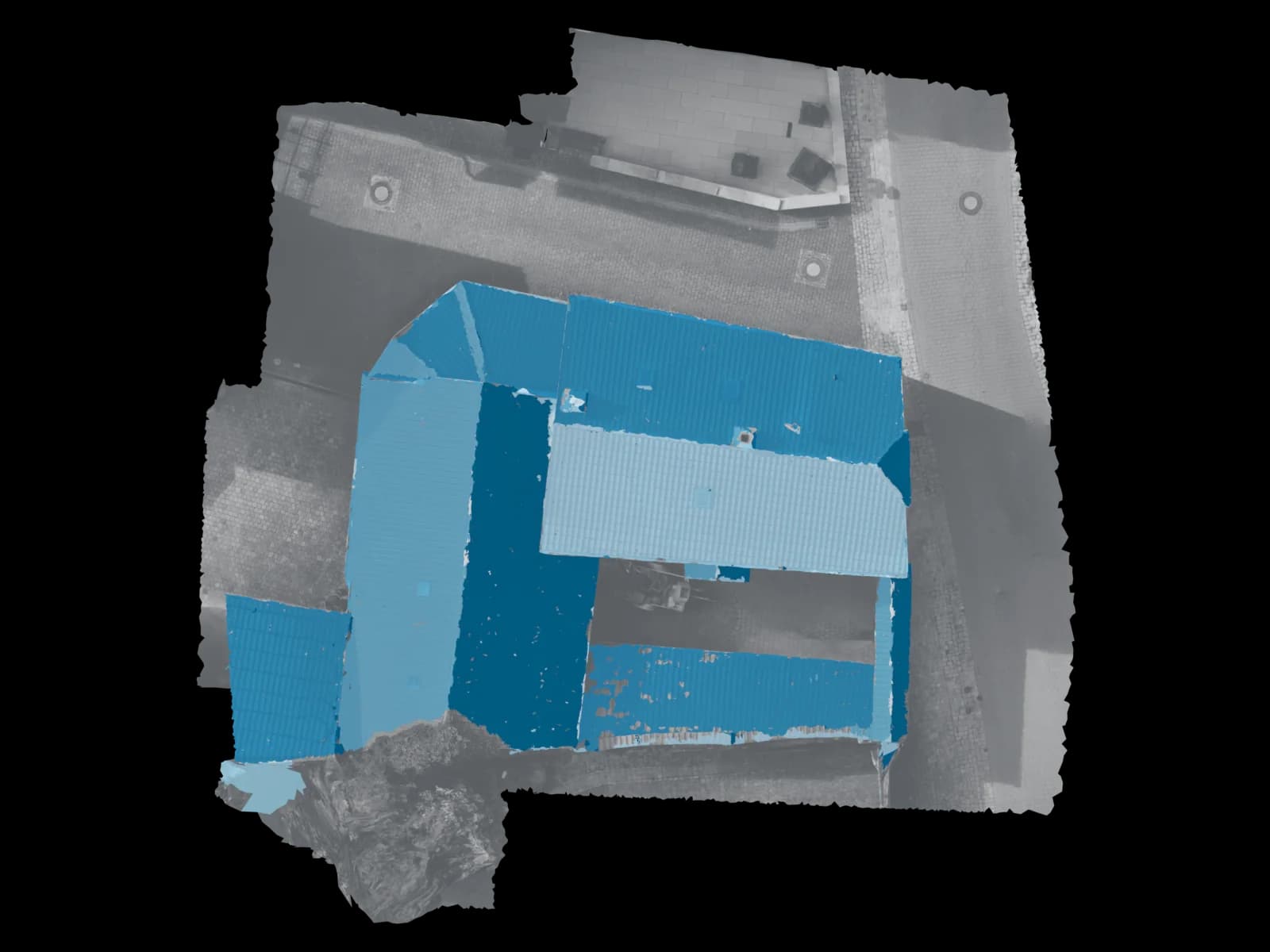
The solution: Drone-based roof surveying combined with professional photogrammetry software. Instead of a technician on the roof, 10–20 minutes of drone flight suffice — and the aerial images produce a precise, fully measured 3D roof model that can be directly imported into PV planning software.
“We've halved our proposal time since we stopped creating roof models ourselves. The quality is better than anything we ever achieved manually.”
How Does Drone Photogrammetry Work for Roof Surveying?
Photogrammetry is the science of deriving precise 3D information from 2D photographs. The principle is the same as human stereo vision: multiple images of the same object from slightly different angles make it possible to calculate depth and shape.
Modern software like Agisoft Metashape or Pix4D processes hundreds to thousands of individual images automatically into a high-resolution 3D model. For a high-quality PV roof survey, these factors are critical:
- Image overlap of 75–85% — every point on the roof must be visible in multiple images
- Sufficient image quality — sharp captures without motion blur, preferably RAW or high-quality JPEG
- Correct GPS metadata — every image needs precise coordinates in the EXIF data
- Even lighting — overcast days without harsh shadows are often better than direct sunlight
- Sufficient flight altitude — typically 15–30m above the ridge for residential homes
Accuracy: What's Really Possible with Drone Roof Surveying?
Achievable accuracy is one of the most frequently discussed topics in the industry. Short answer: It's sufficient for all common PV planning scenarios — and in many cases exceeds the accuracy of manual measurement.
| Factor | Standard Quality | With RTK-GPS | PV Relevance |
|---|---|---|---|
| Positional Accuracy (XY) | 5–15 cm | 1–3 cm | Roof dimensions, module planning |
| Height Accuracy (Z) | 5–10 cm | 2–5 cm | Roof pitch, shading |
| Geometry (Shapes, Angles) | ±2–5 cm | ±1–3 cm | Most critical factor for PV*SOL |
| Roof Surface Area | ±0.5–2% | ±0.1–0.5% | Module count calculation |
| Roof Pitch Angle | ±0.5–1° | ±0.2–0.5° | Yield calculation, shading |
For comparison: A traditional manual roof measurement with tape and angle measure typically achieves ±5–20 cm positional accuracy and ±1–3° angle accuracy. The drone is generally more accurate — and fully automated.
Methods Compared: Drone vs. Manual vs. Satellite Data
| Criteria | Drone + Photogrammetry | Manual Measurement | Satellite/Solar Databases |
|---|---|---|---|
| Geometric Accuracy | ±2–5 cm | ±10–20 cm | ±30–100 cm |
| Obstacles Detectable | Chimneys, dormers, antennas | Manually capturable | Usually not |
| Time per Object | 10–20 min flight | 1–3 hours | Instantly available |
| On-Site Visit Required | Yes (pilot on site) | Yes (technician on roof) | No |
| Direct PV*SOL Import | Yes (direct delivery) | Manual entry | No |
| Data Currency | Same day | Same day | Often 3–5 years old |
| Complex Roof Shapes | Fully captured | Tedious, error-prone | Not possible |
| Cost per Project | From €45 | €150–400 (time + travel) | €5–30 (limited quality) |
PV Software Integration: PV*SOL, Eturnity, and PVcase
The best 3D roof model is worthless if it can't be seamlessly imported into planning software. At Voxelia 3D, models are not just created — they're manually tailored to each target system.
PV*SOL premium
PV*SOL premium by Valentin Software is the most widely used PV planning program in German-speaking countries. It supports importing 3D building models in .obj format. The delivery is provided exactly in this format — including correct scaling, north orientation, and roof surface assignment.
Eturnity
Eturnity is increasingly used for monitoring and digital proposal creation. We deliver a combined bundle of 3D viewer link and compatible model for Eturnity that integrates directly into the Eturnity workflow.
PVcase
For larger ground-mount and commercial installations, PVcase (as an AutoCAD plugin) is the preferred tool. We deliver DTM data (Digital Terrain Model) in DXF format — directly importable into PVcase for shading analysis and module planning.
- Solution3D Roof Model from Drone ImageryDependable roof models for PV planning, viewers, and delivery
- FormatsExport FormatsAll file formats: .obj, DXF, DWG, orthophoto, viewer link
- Workflow3D Roof Model as a ServiceFrom drone imagery to a dependable roof-model delivery
- Viewer3D Viewer for TeamsShare projects, get approvals, document inspections
How Does the Process Work with Voxelia 3D?
The process fits into your existing workflow — no new software, no learning curve.
Capture and upload drone images
Flight with your existing equipment (DJI Mavic, Air, Mini, Matrice etc.). Upload via secure portal or transfer link — JPG, TIFF, or RAW, all formats accepted.
Checked by a person
Every order is reviewed by an expert — no automated black box. We check image quality, overlap, and GPS metadata before reconstruction starts.
Photogrammetry reconstruction
Your drone images become a precise 3D model — with geometric accuracy down to ±2 cm. Complex features like chimneys, dormers, vents, and skylights are fully captured.
Optimization for your target system
The model is tailored to your planning system: PV*SOL-ready .obj, Eturnity bundle, PVcase DTM, DXF for CAD, or georeferenced orthophoto.
Delivery in 12–24 hours
You receive your delivery directly in the dashboard or via download link — including quality report. Ready to use, no rework needed.
Which Roof Types Are Suitable for Drone Surveying?
Drone photogrammetry works for far more than just flat roofs. Complex roof shapes are where the method truly shines.
| Roof type | Suitable | Notes |
|---|---|---|
| Gable Roof | Very good | Standard case — grid flight + ridge orbit |
| Hip Roof | Very good | All roof surfaces and ridge lines precisely captured |
| Flat Roof (Commercial) | Very good | Technical installations, HVAC, parapets |
| Mansard Roof | Very good | Break points fully reconstructed |
| Roof with Dormers | Good (with orbit) | Additional manual orbit recommended |
| Ground-Mount Array | Very good | DTM for PVcase, contour lines, terrain slope |
| Listed Building | Very good | No physical access needed — safe and non-destructive |
Costs and ROI: When Is Drone Roof Surveying Worth It?
Short answer: From the very first project. Here's the math.
| Cost Item | Manual Measurement | Drone + Voxelia |
|---|---|---|
| Fieldwork (Time x Hourly Rate) | €90–180 (1–3h x €60–90) | €0 (no fieldwork) |
| Travel Costs | €15–60 | €0 |
| Office Processing Time | 30–90 min (manual entry) | <5 min (direct import) |
| Voxelia 3D Delivery | — | from €45 |
| Total Cost per Project | ≈ €150–350 | ≈ €45–90 |
With 20 projects per month, that's savings of €2,000–6,000 and up to 60 working hours — time that can be directly invested in more orders. Team Workspace