
Why Drone Images Fundamentally Change Solar Planning
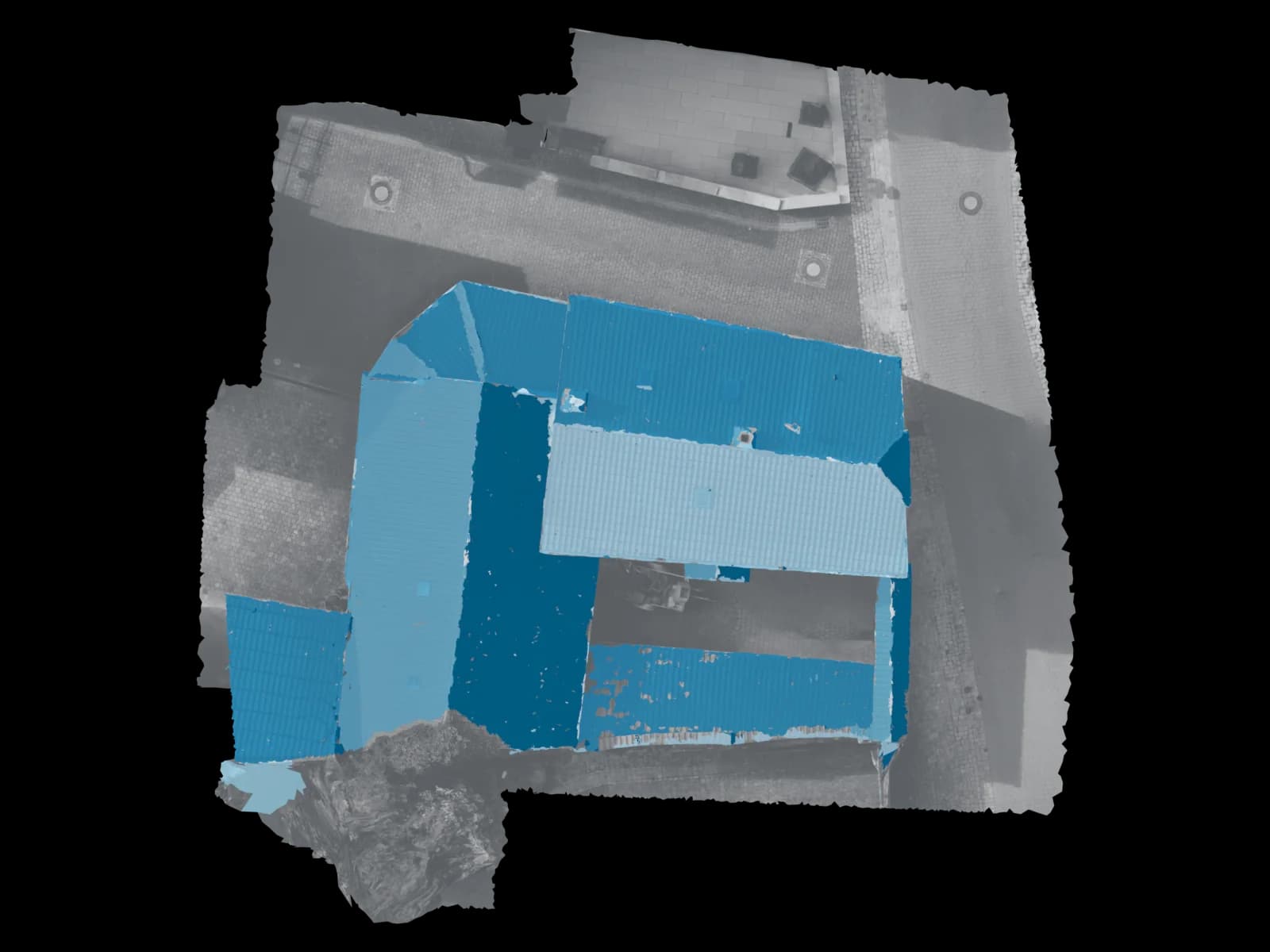
Satellite data has a geometric resolution of 50 cm or more — far too imprecise for solar planning. Snow guards, vent pipes, and skylights simply aren't captured. A modern RTK drone, by contrast, achieves a GSD (Ground Sampling Distance) of 1–3 cm per pixel and maps every obstacle to scale.
The result: Error-free module layouts without costly re-planning. In practice, solar contractors save up to one hour of planning time per project — because the digital model already contains all dimensions, pitch angles, and obstacles.
For complex roofs with dormers, chimneys, or superstructures, drones are simply without alternative: satellite and aerial imagery is often years old and doesn't reflect the current state of the roof.
| Feature | Satellite Data | Aircraft Imagery | Drone Photogrammetry |
|---|---|---|---|
| GSD (Resolution) | 50–100 cm/pixel | 5–20 cm/pixel | 1–3 cm/pixel |
| 3D Accuracy | ±1–5 m | ±10–50 cm | ±1–5 cm (RTK) |
| Currency | 1–5 years old | 1–3 years old | Same day |
| Small objects detectable | No | Partially | Snow guards, pipes, dormers |
| Cost per object | €5–20 (limited quality) | €50–200 | from €45 (PV-ready) |
Technical Requirements for Drone Images in Photogrammetry
The quality of the 3D model stands or falls with the quality of the drone images. Those who know and follow the parameters below get a model directly usable in PV*SOL Premium — without manual rework.
GSD: Ground Sampling Distance
For solar planning, a GSD of less than 2 cm/pixel is the benchmark. With a typical 1-inch camera (12–20 MP), this means a flight altitude of 15–25 m above the ridge. RTK-equipped systems like the DJI Mavic 3E RTK achieve these values reliably even in gusty conditions.
≥ 80% front overlap and ≥ 70% side overlap are minimum requirements. For complex roofs with dormers or steep surfaces, additional oblique shots from 45° angles are recommended to avoid occlusions.
| Sensor | Feature | Description |
|---|---|---|
| Sensor | 1 inch or larger | Smaller sensors (1/2.3 inch) show visible noise above ISO 400. For photogrammetry with texture quality: the larger the sensor, the better the signal-to-noise ratio — especially under overcast skies. |
| Shutter | Global Shutter | Rolling shutter sensors produce distorted images with motion blur, which deforms the point cloud. DJI Mavic 3E and Matrice cameras use global shutter — ideal for photogrammetry. |
| ISO & Aperture | ISO 100–400, f/4–5.6 | Low ISO values minimize noise; medium aperture maximizes depth of field. Shutter speed: at least 1/500s at 15 m/s drone speed to avoid motion blur. |
| Format | RAW Captures | RAW files allow better white balance and exposure correction in post-processing. Agisoft Metashape and Pix4D support DNG natively. JPEG is acceptable, but compression artifacts can impact reconstruction quality. |
RTK, PPK, and GCPs: Centimeter Accuracy for PV Planning
Standard GPS receivers deliver positional accuracies of 2–5 m and height accuracies of 5–10 m. For solar planning, where roof pitch and module area must be accurate to the centimeter, this is simply insufficient.
RTK (Real-Time Kinematic) and PPK (Post-Processing Kinematic) solve this problem through differential GPS correction. The result: 1–3 cm horizontal, 3–5 cm vertical — without placing a single ground control point (GCP).
| Method | Horizontal | Vertical | Field Effort |
|---|---|---|---|
| Standard GPS | 2–5 m | 5–10 m | Very low |
| RTK / PPK | 1–3 cm | 3–5 cm | Low |
| GCPs (without RTK) | 2–5 cm | 4–8 cm | High |
| RTK + Checkpoints | < 2 cm | < 3 cm | Medium |
EU Drone Regulation 2024: What Solar Professionals Need to Know
| Category | Weight | Example | Requirement |
|---|---|---|---|
| A1 | up to 900 g | DJI Mini 3 Pro, Mini 4 Pro | Free EU competence certificate online — no in-person exam required |
| A2 | up to 4 kg | DJI Mavic 3E RTK, Phantom 4 RTK | EU remote pilot certificate (A2) + minimum 30 m distance from uninvolved persons |
| A3 | up to 25 kg | DJI Matrice 350 RTK | Minimum 150 m from residential, commercial, and recreational areas — not suitable for rooftop solar in practice |
| Aspect | Requirement | Since |
|---|---|---|
| Operator registration | LBA registration as drone operator (one-time) | Since 2021 |
| Liability insurance | Legally required drone liability insurance | Since 2021 |
| Remote ID | Electronic remote identification for C1–C3 | Since Jan. 2024 |
| Overflight of residential property | Only with explicit consent of property owner (§21h LuftVO) | Ongoing |
| Flight altitude | Maximum 120 m above ground (BVLOS requires special permit) | Ongoing |
| Visual line of sight (VLOS) | Drone must always remain visible to the naked eye | Ongoing |
From Point Cloud to Finished PV*SOL Model: The Voxelia Workflow
PV*SOL Premium supports importing 3D building models in Wavefront OBJ format. The path from drone flight to imported model involves three clearly separated steps — and Voxelia 3D handles the entire middle part.
- 01
Automated Flight (5–20 Minutes)
Mission planning apps like DJI Pilot 2 or Pix4Dcapture fully automate the flight. Parameters: 15–25 m altitude, 80% front overlap, 70% side overlap, additional oblique shots for complex roof shapes. Images are written directly to SD card or cloud storage.
- 02
Photogrammetric Processing
Cloud platforms like Airteam or Pix4Dcloud process the imagery fully automatically into point cloud, mesh, and texture. Locally, Agisoft Metashape can be used. Voxelia 3D manually reviews the result: point cloud density, mesh quality, texture sharpness, and scale are checked and corrected as needed.
- 03
Import into PV*SOL Premium
The final model is exported in Wavefront OBJ format and optimized for PV*SOL: correct scaling, north orientation, and roof surface assignment. If needed, the model is decimated in Blender to reduce polygon count. In PV*SOL Premium, the model can be activated with a double-click — no manual rework.
Economics & ROI: Own Drone vs. Voxelia 3D
Those operating their own RTK drone for solar planning should budget a total first-year investment of approximately €4,000 (basic package) to €9,000 (pro package). Add ongoing software and insurance costs.
| Cost Item | Basic Package (e.g. DJI Mini) | Pro Package (e.g. Mavic 3E RTK) |
|---|---|---|
| Hardware (drone + accessories) | €1,000–1,500 | €3,500–6,000 |
| Photogrammetry software (p.a.) | €2,000–3,000 | €3,000–5,000 |
| License + insurance | €300–500 | €500–800 |
| Total investment year 1 | ≈ €4,000 | ≈ €9,000 |
Voxelia 3D as a zero-investment alternative: from €45 per delivery — no hardware, no software subscription, no license. For businesses with fewer than 10 PV projects per month, owning a drone rarely pays off. Simply upload images and receive the PV-ready model.
The Future of Solar Planning: Thermography & AI Analysis
| Trend | Title | Description |
|---|---|---|
| Thermography | Detect Defects During Operation | Thermal cameras like the DJI Mavic 3 Thermal detect hot spots, cell breaks, and defective bypass diodes in live PV systems. Thermographic surveys used to cost €300–800 per object — modern consumer drones make it affordable. Combined with the 3D point cloud, defects can be localized to the millimeter. |
| AI Analysis | Fully Automated Layout Plans | AI algorithms analyze 3D roof models and automatically identify usable roof areas, obstacles, and optimal module arrangements. Tools like Nearmap Solar and Aurora Solar already use this technology for US markets. Integration into PV*SOL and similar software in the DACH region is expected in the coming years. |