
What is Photogrammetry?
Photogrammetry is the science of obtaining 3D models, measurements, and descriptions of physical objects from photography alone. In other words: you photograph an object from many angles, and specialized software "reads" these images and reconstructs a precise 3D model.
Photogrammetry's history goes back to the 19th century — originally developed for cartography and surveying. Today it is everywhere: in the drone industry, cultural heritage preservation, construction, and civil surveying. With affordable drones and powerful software, photogrammetry has become the standard method for roof takeoffs, site documentation, and 3D planning.
Core concept: If you photograph the same object from two different perspectives, computer graphics can calculate where points in 3D space must be to appear in the same location in both images. With hundreds of such comparisons, millions of 3D points emerge – a point cloud.
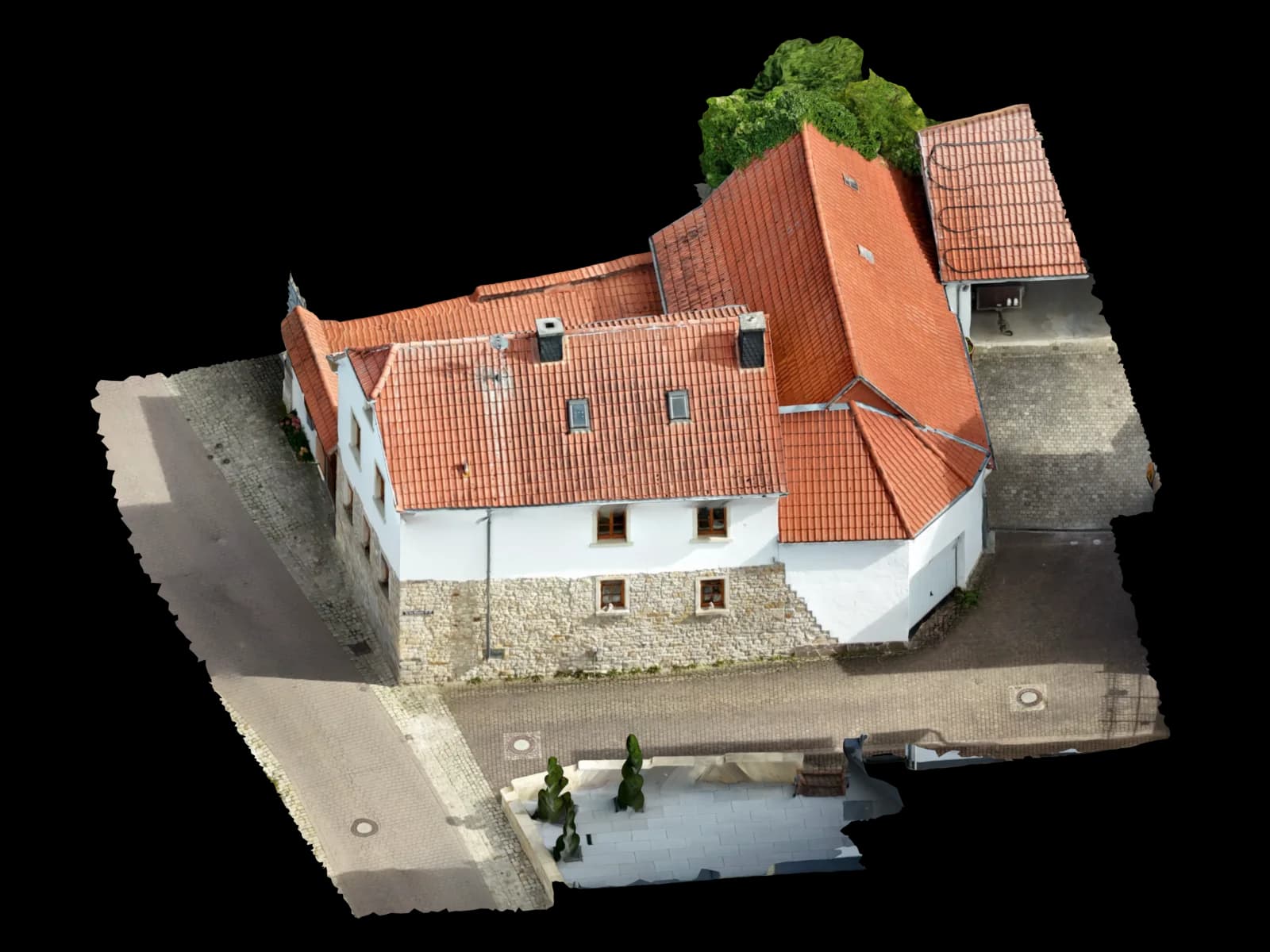
How Does Photogrammetry Work?
The process begins with image capture: a drone or camera photographs an object from many overlapping viewpoints. Minimum overlap between adjacent images should typically be 70%. Higher overlap = more robust reconstruction.
Next comes feature detection: the software identifies characteristic points in each image — edges, corners, textures. This "feature matching" process finds the same features across different images.
The software then calculates 3D coordinates: for each matched feature point, it computes where that point must be in 3D space to appear consistently across all images. Millions of such points create a "point cloud" — a dense 3D representation.
Finally, mesh generation occurs: a surface model (mesh) is created from the point cloud — a network of triangles representing the object's surface. Optionally, textures (colors) from the original images are projected onto this mesh.
Drones for Photogrammetry
Drone selection is critical for quality and efficiency. The professional market is dominated by DJI. For photogrammetry, these criteria matter: camera sensor (size, resolution), focal length, RAW support, flight altitude, and flight duration.
The DJI Mavic 3 Pro is popular for budget projects: 4/3 camera (20MP), 20mm focal length, 31 min flight time, no RTK. Cost: ~€2,000. For high-accuracy RTK surveys, the DJI Matrice 350 RTK is the standard: Zenmuse H30T camera, 2-3cm RTK accuracy, up to 55 min flight time. Cost: ~€15,000 + ground stations.
Software Comparison
There are three categories: open-source (free, technical knowledge required), commercial desktop software (one-time or subscription license), and cloud processing (pay-as-you-go). Each has trade-offs.
Popular commercial tools: Pix4D (from €500/month, web-based, excellent UX), Agisoft Metashape (€2,000 one-time, local, GPU-accelerated), RealityCapture (fastest engine, cloud). Open-source alternatives: OpenDroneMap, Meshroom, COLMAP.
Accuracy & Quality
Accuracy is measured in GSD (Ground Sample Distance): how many cm one pixel represents. With 2cm GSD, 1 pixel = 2cm. For roof planning, 1-3cm GSD is typical. RTK adds 2-3cm horizontal accuracy.
Visual inspection requires ±5-10cm. For CAD import and PV planning, target ±2-3cm horizontal and ±3-5cm vertical. With GCP and RTK, <2cm is achievable.
Use Cases
Photogrammetry is used across many industries: solar planning (roof surveys for PV), site documentation, surveying, heritage preservation, real estate marketing, infrastructure inspection, forensics, and archaeology.
In the energy transition, solar planning is a growth area: precise roof models enable automated PV yield calculation and shading analysis. With Voxelia, you get roof surveys in 12-24h ready for PV*SOL or CAD import.
Export Formats
Photogrammetry software exports in various formats depending on use case: OBJ (3D mesh with texture), PLY (point cloud), FBX (animation/game engines), LAS/LAZ (georeferenced survey data), DXF/DWG (CAD), GeoTIFF (orthophoto), TIFF (elevation model).
For GIS integration, GeoTIFF or LAS is standard. For CAD import, use DXF + separate orthophoto PNG. For 3D visualization in WebGL or game engines, FBX or GLB is optimal.
Photogrammetry vs LiDAR
Photogrammetry and LiDAR are two different surveying technologies. Photogrammetry uses cameras and feature-matching; LiDAR measures distances directly with lasers. Each has strengths.
Photogrammetry: cheaper, provides color textures, requires structured surfaces. LiDAR: expensive, works on reflective surfaces, no textures, but faster. For solar roof planning, photogrammetry is usually sufficient and more economical.
Regulations & Drone Laws
In the European Union (including Germany, Austria, Switzerland), drone operation is regulated by EU Regulation 2019/947 and 2019/945. Pilots need one of three licenses: A1 (small drones <250g, below 120m), A2 (commercial drones up to 500g), A3 (large drones or uncontrolled airspace).
Operating permits may also be required — especially for flights over residential areas or restricted airspace. These are issued by aviation authorities (in Germany: state aviation offices). For commercial photogrammetry, at least an A2 license is typically required.
Costs & ROI
Total cost consideration for photogrammetry services includes: drone hardware (€2,000-€15,000), software licenses (€500-€2,000/month or one-time), pilot license (€100-€500 one-time), ground stations/RTK (optional, €5,000-€10,000).
For individual projects, it's often more economical to use service providers like Voxelia. Our pricing: from €45 per project for simple roof surveys, €200-€500 for complex RTK measurements. ROI is quick if photogrammetry data improves project planning and reduces costs.
Future of Photogrammetry
The future of photogrammetry is shaped by three trends: (1) AI-accelerated processing — neural networks detect features faster and more robustly than traditional algorithms. (2) NeRF (Neural Radiance Fields) — new technology for photorealistic 3D reconstruction from fewer images. (3) Gaussian Splatting — faster and more memory-efficient than traditional meshes.
These technologies will accelerate processing, improve accuracy, and enable new use cases — like real-time reconstruction on drones or volumetric video for immersive VR experiences.
Glossary
| Term | Definition |
|---|---|
| Feature Matching | Process by which software identifies and matches characteristic points (features) across images to find correspondences. |
| GSD (Ground Sample Distance) | Spatial resolution: how many cm or mm one pixel represents in real-world distance. |
| RTK (Real-Time Kinematic) | GPS correction system that improves horizontal accuracy from ~3-5m to 2-3cm. |
| Mesh | Surface model composed of triangles created from a point cloud. |
| Orthophoto | Distortion-free, vertically aligned aerial image with geographic referencing. |