
Why Facade Surveying with Drones?
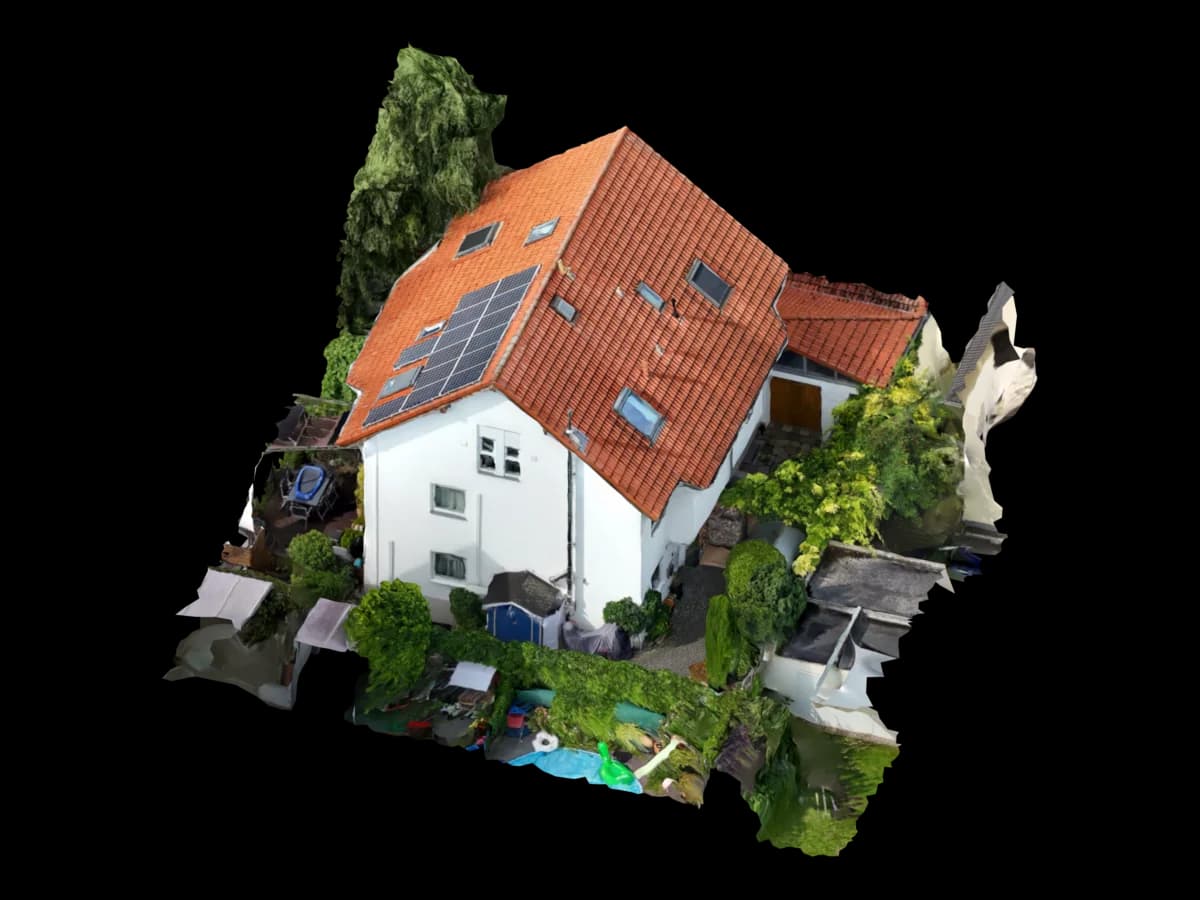
Traditional facade surveys are expensive, time-consuming, and dangerous. Scaffolding alone costs €2,000–8,000, manual surveys are error-prone and take days. Drones change that completely.
With a modern surveying drone, an entire facade can be captured in 20–45 minutes. Accuracy (±5 mm with modern photogrammetry) is sufficient for renovation planning, energy consulting, and even heritage preservation.
The biggest advantages: No scaffolding costs, 80% time savings, safe capture of hard-to-reach areas, 3D models for further planning, and reproducible before/after comparisons.
Drone facade surveying is especially suitable for residential buildings, industrial structures, heritage sites, energy audits (BAFA), and large apartment buildings.
Typical Use Cases
Renovation & Refurbishment: Accurate capture of facade condition, window positions, surfaces for material planning. Basis for cost estimation.
Heritage Preservation: 3D documentation before work (authority requirement), damage mapping, comparisons over time.
Energy Audit & BAFA: Documentation for grant applications. BAFA subsidies up to 80% for energy consulting — drone data increases authority approval rates.
Damage Analysis: Systematic capture of cracks, soiling, deterioration. Thermal imaging possible (RGB + thermal cameras).
Construction Handover & Documentation: Objective acceptance photos, digital building records, long-term defect tracking.
Technical Requirements for Facade Surveying
Ground Sampling Distance (GSD): For facades, GSD (pixel size on ground) should be 2–5 mm. At typical facade heights of 10–30 m, this delivers optimal detail sharpness.
Flight Planning: Manual: Requires experience but flexible. Automated (e.g., DroneDeploy, Pix4DFields): Precise overlap control (80% vertical, 60% horizontal minimum), saves time, reproducible.
Camera Settings: ISO 100–200 (low noise), aperture f/2.8–f/4 (good depth of field), shutter speed <1/500s (avoid motion blur). Manual exposure important under varying light.
Flight Pattern: Grid pattern (uniform raster) for flat facades. For L-shaped or complex forms: Multiple flight directions or spiral patterns.
Sensor Size: 1-inch sensors (e.g., DJI Mavic 3E) or larger for better noise characteristics in poor lighting.
Accuracy & Measurement Methods: Photogrammetry vs. Laser Scanning vs. Manual
Photogrammetry (Drone Standard): Accuracy ±3–5 mm under optimal conditions. Cost €500–2,000 depending on object size. Duration: 2–4 days (flight + processing). Ideal for facades; visibility is prerequisite.
Laser Scanning (Terrestrial + Drone): Accuracy ±1 mm, but 5–10x more expensive (€2,500–10,000). Overkill for simple facades; worthwhile for complex industrial structures.
Tacheometry (Classical Surveying): Accuracy ±5–10 mm, cost similar to drones, much longer (1–2 weeks). Usually combined with drone data as reference.
Manual Measurement (Traditional): Accuracy ±50 mm (human error), expensive scaffolding, time-consuming, dangerous. Today only for small detail work.
Workflow: From Flight to Facade Plan
Phase 1 — Planning (0.5–1h): On-site visit, height measurement, weather check (wind, clouds), permits (flight corridor, private property), reference points (Ground Control Points for higher accuracy).
Phase 2 — Flight (0.5–1h): Drone flight with camera overlap (80% frontal, 60% lateral). At 15 m facade height: ~100–200 images. Drone flies systematically; pilot supervises.
Phase 3 — Data Processing (4–8h): Upload images to Agisoft Metashape or Pix4D. SfM algorithm creates point cloud (~1–10 million points), then mesh (surface reconstruction), then orthophoto (2D scaled image).
Phase 4 — Modeling & Measurement (2–4h): Refine 3D model in CloudCompare or AutoCAD. Fix errors (automatic reconstruction isn't perfect). Extract measurements: window widths, facade heights, damage boundaries.
Phase 5 — Export & Handover (1h): CAD plans (DWG, PDF), 3D model (OBJ, LAS point cloud), orthophoto (GeoTIFF with scale). Documentation: metadata, accuracy, method.
Phase 6 — Client Uses Data: For planning in CAD (renovation design), for surveying (measurements in facade plan), for BAFA application (energy consulting), for insurance (damage documentation).
Costs & Economics
Typical costs for drone facade surveying (Voxelia service prices):
• Simple facade up to 300 m²: €500–900
• Medium facade 300–1,000 m²: €900–1,800
• Large/complex facade >1,000 m²: €1,800–2,500
• With thermal imaging or drone laser scanning: +€500–1,500
Comparison: Traditional Method
• Scaffolding setup (standard): €2,000–5,000
• Manual survey (3–5 days): €1,500–3,000
• Scaffolding removal: €1,000–2,000
• Total: €4,500–10,000 + 5–7 days
ROI for professional surveying teams: In-house hardware (€6,000–8,000 for professional drone + software) pays for itself after 5–10 drone deployments per year.
BAFA subsidies reduce own costs: Many energy consulting subsidies cover 80% of surveying costs — effective own cost often only €100–300.
Legal Framework in Germany
EU Drone Regulation (2019/947): New standards since 2024. All drones must be CE marked, Remote ID mandatory (traceable for authorities).
Flight Height & Distances: Max 120 m altitude (often 100 m locally in Germany). Minimum distance to people/buildings: 5 m (Open Category); categorized operation possible for technical surveying.
Permits in Urban/Residential Areas: Local district/city often requires permission (existing buildings, private property). Voxelia obtains permits. Processing time: 2–4 weeks (plan accordingly!).
Data Protection: Images of private property belong to owners. Unidentifiable faces in photos (§23 German Copyright Act). On business premises: employer permission needed.
Insurance: Liability insurance strongly recommended (often legally required). Covers personal injury, property damage up to €1 million.
Land Use & Building Plans: Check for air space restrictions (airports, airfields, radio stations). Radius often 5–15 km around airports.