
What is 3D Property Modeling with Drones?
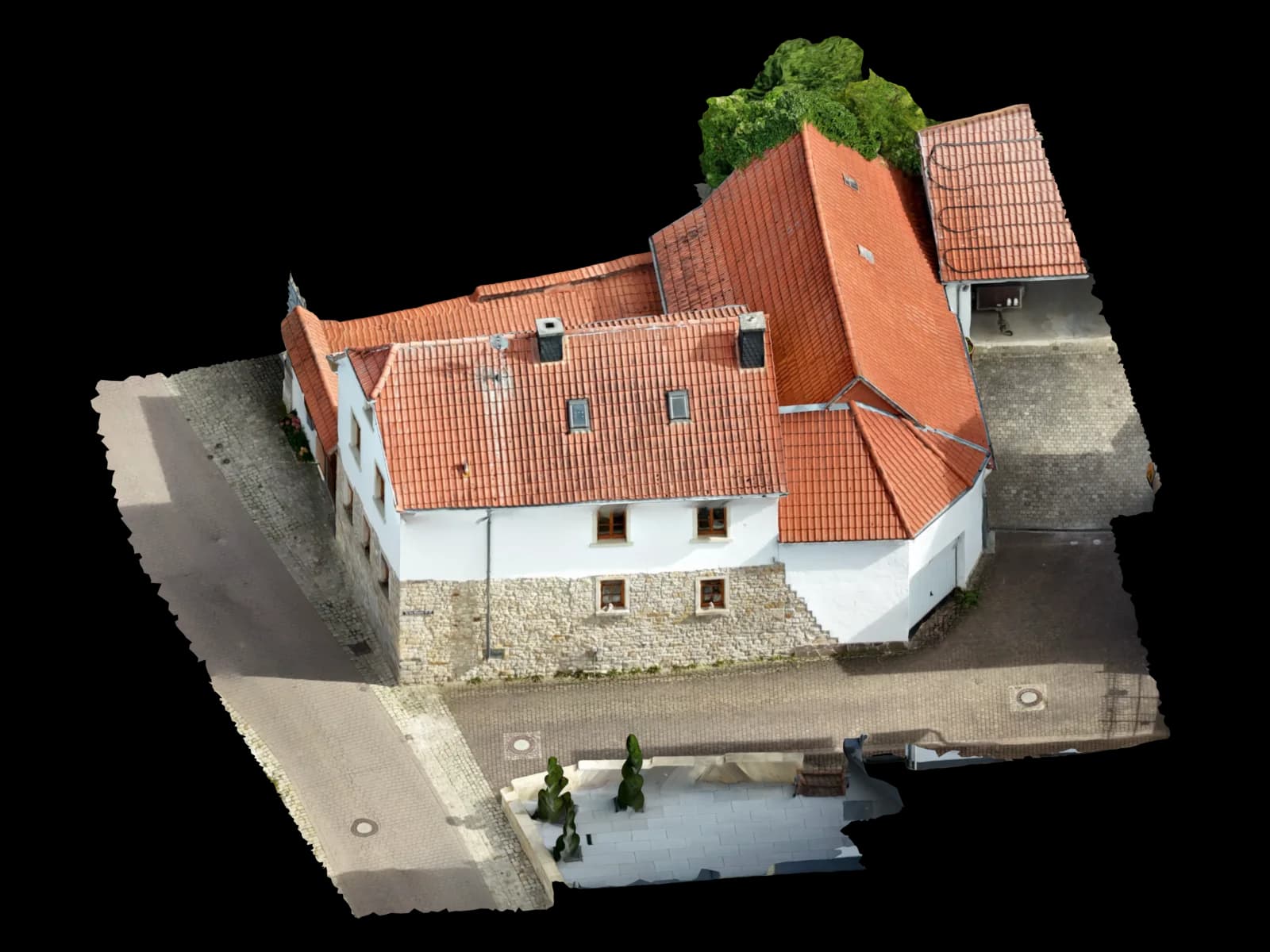
In drone-based 3D property modeling, a property is systematically overflown and photographed from the air. From hundreds of overlapping images, photogrammetry software calculates a centimeter-accurate digital 3D model of the entire terrain.
The result is a complete digital replica of your property: terrain shape, elevation differences, buildings, vegetation, paths, walls and all other objects — true to scale and georeferenced.
This technology replaces labor-intensive on-site surveys and delivers significantly more data: instead of individual measurement points, you receive a full-coverage 3D point cloud with millions of data points.
Applications
Construction Planning & Architecture
Precise terrain models as a planning basis: contour lines, cross-sections, volumes. Architects can fit designs directly into the real terrain.
Real Estate Valuation & Listings
3D models and orthophotos for agents and appraisers: property size, topography, neighboring buildings — all documented and measured.
Landscaping
Terrain surveys for terrace planning, earthworks, planting and path construction. Earthwork calculations directly from the 3D model.
Infrastructure Planning
Digital terrain models for sewer, road and utility planning. Precisely determine elevation profiles and gradients.
As-Built Documentation
Completely digitally capture the current state of a property — as a basis for renovation, remodeling or insurance documentation.
Solar Potential Analysis
Shading analysis and roof area calculation: consider trees, neighboring buildings and terrain shape in the 3D model.
Workflow: From Drone to 3D Property Model
Flight Planning
Define property boundaries, set flight altitude (40–80 m), configure image overlap (75–85%).
Ground Control Points (optional)
For maximum accuracy: survey GCPs with RTK-GPS. Often not needed with RTK drones.
Drone Flight
Automated grid flight over the property. Additional oblique shots for facades and slopes.
Data Processing
Photogrammetric processing: image alignment → dense point cloud → mesh → texturing → orthophoto.
Terrain Model Creation
Point cloud filtering: remove vegetation and objects → pure Digital Terrain Model (DTM).
Quality Control
Verification against reference points, completeness check, artifact cleanup.
Export & Delivery
Delivery as 3D mesh (OBJ/FBX), point cloud (LAS), DTM (GeoTIFF), orthophoto (TIFF/JPG) and CAD plan (DXF).
Technologies Compared: Photogrammetry vs. LiDAR
Two main technologies are used for 3D property modeling:
| Criterion | Photogrammetry | LiDAR |
|---|---|---|
| Cost | €300–1,500 | €2,000–10,000 |
| Accuracy | ±2–5 cm | ±1–3 cm |
| Texture / Color | Photorealistic | None (geometry only) |
| Vegetation Penetration | No | Yes (ground under trees) |
| Weather Dependency | High (light needed) | Low (works in clouds) |
| Processing Time | 2–5 days | 1–3 days |
| Best Suited For | Open terrain, buildings | Forested areas |
What Does 3D Modeling of a Property Cost?
Costs depend on property size, desired accuracy and delivery scope:
| Property Size | Standard Package | Premium Package | Delivery Time |
|---|---|---|---|
| Up to 500 m² (Garden) | €300–500 | €600–900 | 3 days |
| 500–2,000 m² (Residential) | €500–900 | €900–1,500 | 3–5 days |
| 2,000–5,000 m² (Commercial) | €800–1,500 | €1,500–2,500 | 5–7 days |
| 5,000–20,000 m² (Large Area) | €1,500–3,000 | €3,000–6,000 | 7–14 days |
| > 20,000 m² (Campus) | Individual | Individual | By arrangement |
Accuracy & Quality Factors
The accuracy of a drone-based 3D property model depends on several factors: RTK correction signal, flight altitude, image overlap, GSD (Ground Sample Distance) and ground control points.
With RTK drones and optimal flight planning, you achieve ±2–3 cm positional accuracy and ±3–5 cm vertical accuracy. This is more than sufficient for construction planning, landscaping and infrastructure.
For cadastral surveys (boundary determination), a publicly appointed surveyor is required. However, drone data can serve as supplementary documentation and reduce overall effort.
Which Property Types are Suitable?
| Property type | Suitability | Notes |
|---|---|---|
| Building Plot (undeveloped) | Excellent | Ideal conditions: clear view, minimal vegetation. Highest accuracy achievable. |
| Residential Property (developed) | Excellent | Building, garden and driveway are fully captured. Oblique shots recommended for facades. |
| Hillside Property | Excellent | Drones excel here: terrain profiles and contour lines without climbing. |
| Wooded Property | Limited | Photogrammetry captures tree canopies, not the ground. For terrain model under trees: LiDAR required. |
| Commercial Property | Excellent | Large areas captured efficiently. Ideal for as-built surveys and development planning. |
| Agricultural Land | Excellent | Large areas in short time. Orthophotos and DTM for drainage planning and soil analysis. |
Drone vs. Traditional Property Survey
| Criterion | Drone (Photogrammetry) | Total Station |
|---|---|---|
| Cost (1,000 m²) | €400–800 | €1,500–3,000 |
| On-site Time | 30–60 min | 4–8 hours |
| Data Density | Millions of points/m² | 10–50 points/m² |
| Result | 3D model + orthophoto + point cloud | Individual points + site plan |
| Accuracy | ±2–5 cm | ±1–2 cm |
| Cadastral Survey | Not possible | Possible (with surveyor) |
| Reusability | Model valid 3–5 years | Point-in-time only |
How to Order from Voxelia
Provide property address and approximate area
Choose delivery formats (3D model, DTM, orthophoto, CAD)
Receive free quote (within 2 hours)
Upload drone images or schedule flight
Receive QA-checked 3D model (3–7 business days)