
What is an As-Built Survey?
An as-built survey captures the actual existing state of a building or site as a foundation for planning, renovation, conversion or handover. It documents what exists in reality, not what was originally designed — critical for any renovation or extension project where the original plans may be missing, inaccurate or outdated.
Traditionally, as-built measurement was carried out with tape measures, laser distance meters and hand sketches. This is time-consuming, error-prone and requires scaffolding or elevated work platforms for large or difficult-to-access buildings such as industrial halls, heritage structures or complex façades. Drone photogrammetry fundamentally changes this process: instead of hours of on-site measurement, a 30–90 minute drone flight delivers a complete, millimetre-precise point cloud of the entire exterior.
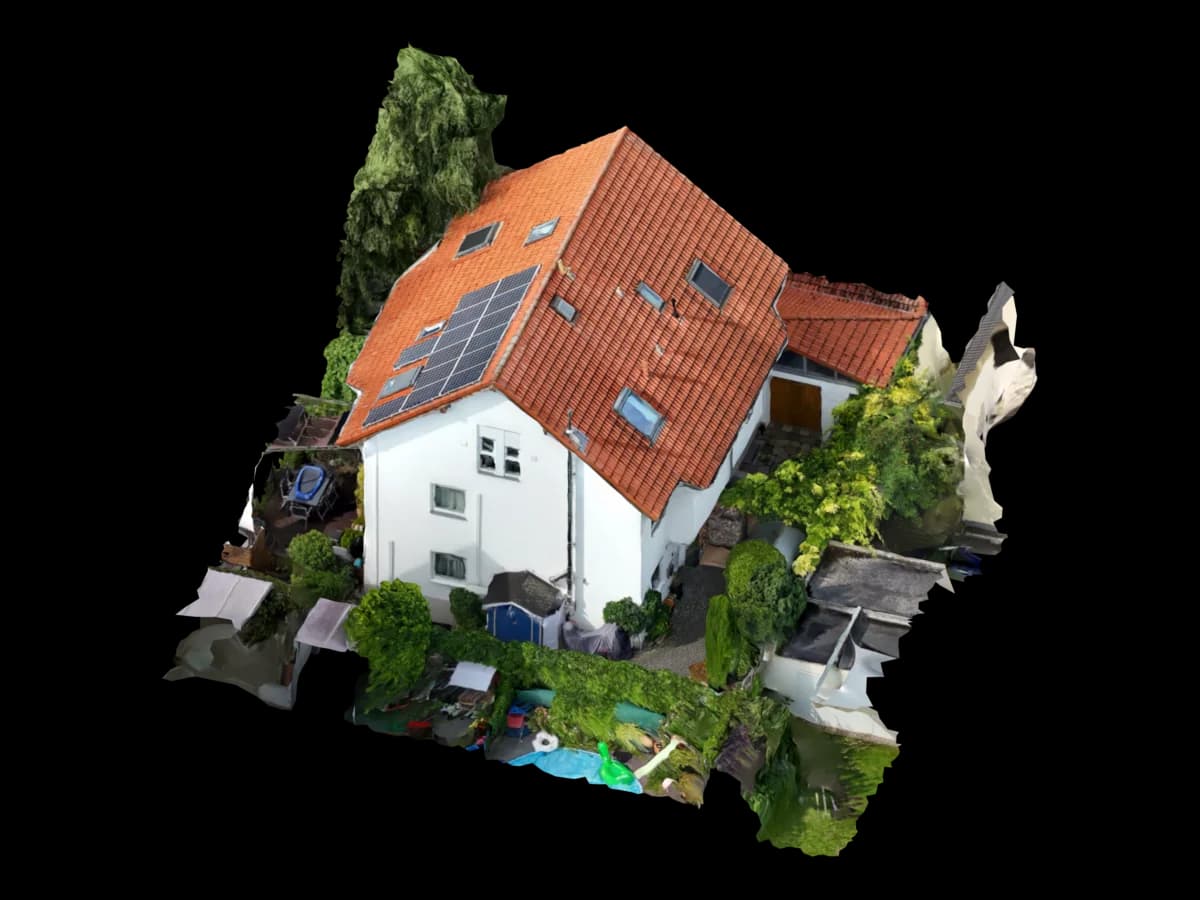
The result is not simply a photograph but a three-dimensional, true-to-scale data model. From this, as-built plans in DXF/DWG, georeferenced point clouds in RCP format for Autodesk ReCap, BIM-ready IFC files or classic orthophotos can all be derived in a single processing step.
Advantages of Drone Method over Manual Survey
Manual measurement quickly reaches its limits for complex buildings: steep roofs, tall façades, inaccessible roof landscapes or large industrial facilities require scaffolding, elevated work platforms, or simply cannot be completely captured manually. Drone photogrammetry delivers a complete, contactless aerial survey instead.
The decisive advantage lies in the combination of speed and accuracy: a single-family home is fully surveyed in 20–40 minutes of flight time, a multi-family building with complex roof geometry in 60–90 minutes. The absolute positional accuracy of ±2–3 cm with RTK-GNSS surpasses manual measurement across large areas, where error propagation in long measurement chains often leads to worse results. There is also a safety dimension: no climbing onto roofs or scaffolding, no personnel at risk.
A further advantage is reproducibility: the raw data (images, point cloud, orthophoto) remain archived and can be reprocessed at any time. This creates a complete construction documentation record that is immediately available in disputes, insurance claims or future renovation projects.
| Criterion | Drone as-built survey | Manual survey |
|---|---|---|
| Survey time – single-family home | 20–40 min flight | 4–8 hrs on site |
| Absolute positional accuracy | ±2–3 cm (RTK) | ±1–5 cm (error-prone in chains) |
| Steep roof accessibility | complete, contactless | scaffolding or platform required |
| Output formats | DXF, RCP, IFC, OBJ, Orthophoto | hand sketch, individual measurements |
| Reproducibility | anytime, re-derivable from raw data | not reproducible |
| Staff required | 1 pilot + post-processing | 2–3 persons on site |
| Safety risk | no fall risk | fall hazard on roofs / scaffolding |
Workflow: From Drone Flight to Finished As-Built Plan
The process is divided into four clearly defined phases. In flight planning, overlap rate, flight altitude, GSD (ground sample distance) and georeferencing method are determined. For an as-built survey with planning requirements, a GSD of 1–2 cm and frontal overlap of at least 80%, lateral overlap of at least 70% is recommended. With RTK-GNSS, ground control points (GCPs) are not required, significantly reducing on-site effort.
After the drone flight, image processing takes place in photogrammetry software. The software calculates a dense point cloud from the overlapping individual images, followed by a textured 3D mesh and a georeferenced orthophoto. Common software tools are Agisoft Metashape, Pix4Dmapper and RealityCapture – all three support export to LAS/LAZ (point cloud), OBJ, DXF and GeoTIFF.
In the third step, the point cloud is cleaned and classified: vegetation, vehicles and movable objects are removed, building surfaces, roof and ground are labelled as separate classes. From the cleaned point cloud, horizontal and vertical section views can then be derived via cutting planes, importable directly as as-built plan bases into AutoCAD, BricsCAD or Revit.
In the final step – the actual as-built plan – line geometry is vectorised from the point cloud sections: exterior walls, roof edges, ridge lines, roof slope angles and openings are laid out as DXF/DWG layers. For BIM-compliant deliveries, the model is further developed in Revit as RVT or exported directly as IFC 2×3 / IFC 4.
Applications of Drone As-Built Surveys
Renovation and Modernisation: Before any energy retrofit or structural extension, the existing building must be precisely documented. Drone surveys deliver façade dimensions, roof geometries and eaves heights in a single operation – without a survey team having to access the building exterior. The data feeds directly into energy consulting or into the detailed design phase.
Heritage Conservation and Historic Buildings: For listed buildings, detailed construction documentation is often a prerequisite for building permits and public funding. Drone photogrammetry delivers true-to-scale orthophoto plans of all façades together with three-dimensional point clouds with material capture – ideal for restoration planning in line with conservation guidelines.
Handover Documentation on Construction Projects: At the end of a construction project, a drone as-built survey creates a complete, dated record of the actual construction state. This protects both clients and contractors equally in warranty disputes. Together with the 3D viewer, the documentation data can be shared and archived via web browser.
Property Valuation and Due Diligence: For the sale or valuation of commercial properties and existing buildings, drone as-built surveys replace time-consuming manual area and volume calculations. Gross floor area, gross volume and building heights can be derived directly from the 3D model – traceable and audit-proof.
Accuracy, Quality Assurance and Standards
The achievable accuracy of drone as-built surveys depends on three factors: camera sensor and lens, flight altitude / GSD, and georeferencing method. With RTK-GNSS (Real-Time Kinematic), absolute positional accuracies of ±2–3 cm in plan and ±3–5 cm in height are achieved. These values apply under normal conditions without severe atmospheric disturbances and with adequate GNSS satellite visibility.
Without RTK, i.e. with standard GPS accuracy only, ground control points (GCPs) must be surveyed to achieve comparable absolute accuracies. GCPs are physically signalled points in the terrain whose precise coordinates are determined by DGNSS or total station. The effort of GCP surveying and signalling is completely eliminated with RTK, making RTK drones significantly more economical for as-built surveys.
The relevant standard for photogrammetric surveys is VDI 2634 (Parts 1–3), which defines test procedures and accuracy classes for optical 3D measuring systems. For architectural as-built surveys, the recommendations of the German Society for Photogrammetry, Remote Sensing and Geoinformation (DGPF) are also relevant, particularly the guidelines on accuracy requirements and quality records for construction surveys.
Output Formats for Architects and Planners
The result of a drone as-built survey is available in different formats depending on requirements. For CAD post-processing in AutoCAD, BricsCAD or QCAD, DXF/DWG is the standard format: the vector data contains line geometry for roof edges, exterior walls, ridge lines and roof slopes, structured in layers following the GAEB layer standard or project-specific agreement.
For BIM workflows in Revit or ArchiCAD, importing the point cloud as RCP/RCS (Autodesk ReCap) is recommended. From the point cloud in Revit, walls, slabs and roof surfaces can be modelled directly as parametric Revit elements. Alternatively, IFC export (IFC 2×3 or IFC 4) delivers a BIM-ready handover format compatible with all major open-BIM software.
The georeferenced orthophoto (GeoTIFF) is the planning-relevant 2D product: a distortion-free, true-to-scale aerial image with EPSG coordinate system (typically ETRS89/UTM Zone 32N for Germany). It can be imported directly into GIS software (QGIS, ArcGIS) or as a background plan in CAD applications. For presentations and handover documentation, a WebGL-based 3D viewer link is also available, opening in the browser without additional software.
Costs of Drone As-Built Surveys
The costs of a drone as-built survey are composed of flight time, post-processing effort and the chosen output format. Simple documentation (orthophoto + point cloud without CAD vectorisation) is significantly cheaper than complete as-built plans with DXF line geometry and BIM-ready IFC delivery.
The following price ranges serve as indicative benchmarks. These refer to exterior areas (roof, façades, site). Interior surveys with terrestrial laser scanners are separately commissioned and typically 3–5× more expensive per room captured.
Compared to classic manual survey, the drone method pays off even for medium complexity: a survey team requires 2–3 working days for a multi-family building with 6 units and a complex hipped roof (including scaffolding costs), resulting in total costs of €2,500–€5,000. The drone as-built survey for the same building typically costs €690–€990 – with higher data density and reproducible raw data.
| Object / building | Price | Scope | Delivery |
|---|---|---|---|
| Single-family home (exterior) | from €290 | Orthophoto + point cloud + DXF roof edges | 2–3 working days |
| Multi-family building (4–8 units) | from €490 | Orthophoto + point cloud + DXF as-built plan | 3–4 working days |
| Commercial / industrial building | from €790 | Orthophoto + RCP point cloud + DXF + IFC | 4–5 working days |
| Heritage / listed building | from €990 | Orthophoto all façades + OBJ mesh + DXF + photo documentation | 5–7 working days |
| Large facility / industrial site | on request | individual by area and level of detail | by agreement |