
What is Drone-Based Construction Progress Documentation?
Construction progress documentation captures the as-built state of a site at regular intervals – from excavation through the shell to completion. Traditionally, site managers, project controllers, or photographers handle this on foot with hand cameras. The results are patchy, not to scale, and barely reproducible.
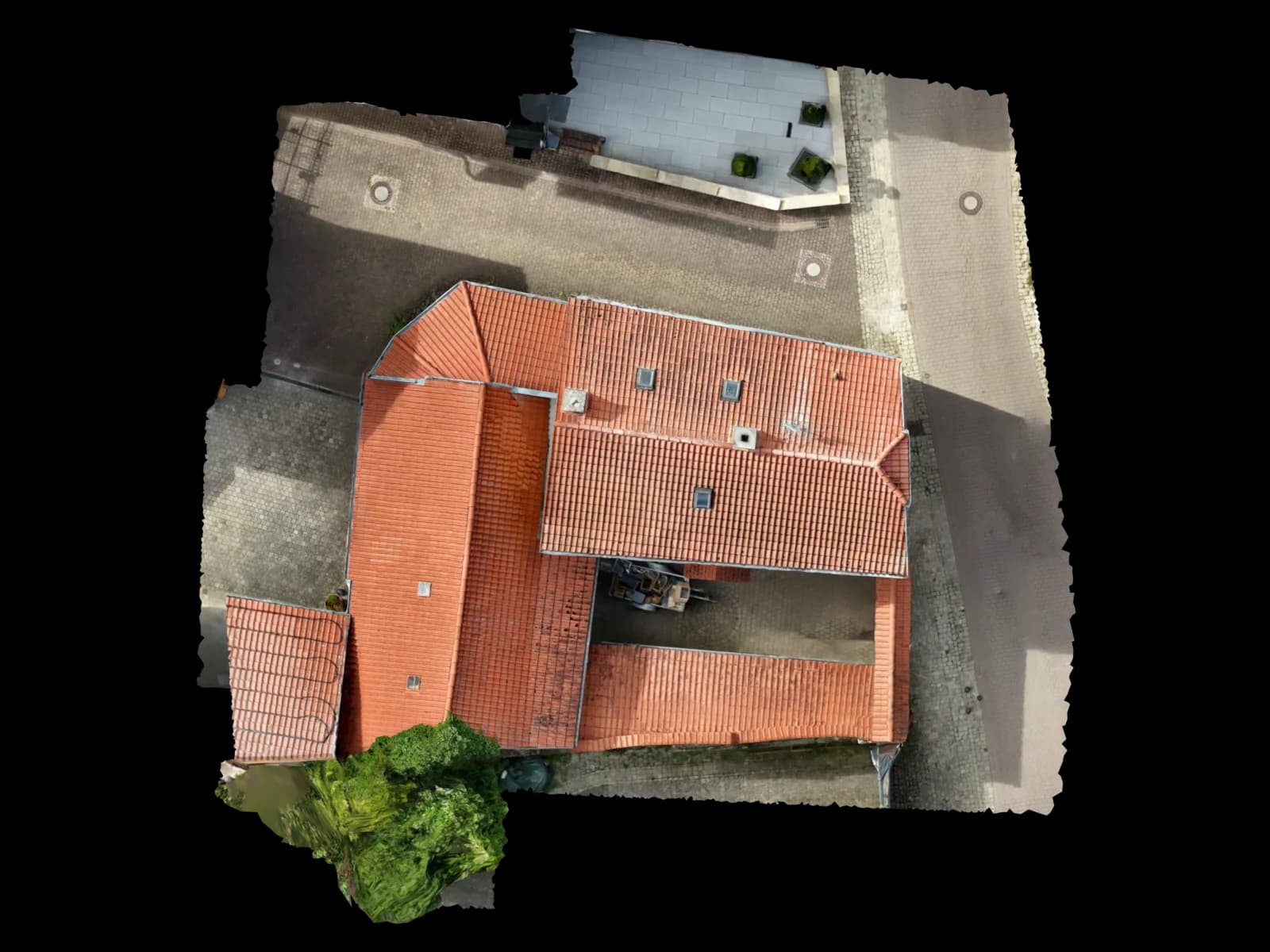
Drone photogrammetry solves this fundamentally: a drone flies an automated grid pattern over the entire construction site, capturing hundreds of overlapping images. Processing software – typically Agisoft Metashape, Pix4Dsurvey, or DroneDeploy – calculates a georeferenced orthophoto, dense point cloud, and digital surface model (DSM). The entire drone flight for a mid-sized site (1–5 ha) takes just 20–40 minutes.
The result is not just an aerial photograph but a true-to-scale, fully measurable digital replica of construction progress. Distances, areas, and volumes can be read directly from the model. Sequential flights enable precise comparisons: what has been excavated, filled, or built since the last survey?
Applications: Where Does Drone Monitoring Pay Off?
Drone construction progress documentation is valuable wherever regular, area-wide status documentation is needed and manual inspections are too time-consuming, too hazardous, or insufficiently reproducible.
Vertical construction projects (apartment buildings, commercial buildings, industrial halls) benefit especially during the shell phase: floor slabs, wall heights, and column configurations can be documented weekly and compared against the planning status. For roof structures, facade elements, and finishing trades, the bird's-eye view is indispensable – manual inspection would require fall protection.
Civil engineering and infrastructure projects are the classic use case for volumetric assessments: earthworks, excavation, ground fill, and embankment profiles are regularly captured by drone and compared directly with excavation or fill volumes from the previous survey. This is far faster than manual total station measurement and enables continuous, traceable quantity tracking.
Neighborhood developments and large sites with multiple construction zones need an overview simply not achievable from ground level. Drones deliver this overview in minutes – as a basis for site meetings, control reports, and communication with investors or authorities.
| Criterion | Drone documentation | Manual inspection |
|---|---|---|
| 5 ha site coverage | complete, 20–35 min flight | partial areas, 4–8 hrs walk |
| True-to-scale output | yes, georeferenced orthophoto + 3D model | no, hand photos without reference |
| Volume calculation | automatic from DSM/DTM | manual, total station required |
| Reproducibility | always, re-derivable from raw data | not reproducible |
| Time to report | 24–48 hrs after flight | 2–5 business days |
| Safety on roofs / scaffolding | no access needed | fall protection required |
| Suitability for BIM comparison | yes, point cloud directly importable | no |
Workflow: From Survey Flight to Finished Build Report
A complete construction progress documentation cycle typically runs in four phases. Step 1 – Flight planning and survey: The drone flies a pre-planned grid pattern (lawnmower) over the site. Altitude, image overlap (typically 80% frontal, 60% lateral), and speed are matched to the required ground sampling distance (GSD). At 50 m altitude with a 45-megapixel camera, GSD is approx. 1.2 cm – more than sufficient for progress reports.
Step 2 – Georeferencing: For accurate, absolutely georeferenced results, an RTK-GNSS drone is used. Images are corrected in real time using NTRIP correction streams from official networks (SAPOS in Germany). Optionally, ground control points (GCPs) can be surveyed on site – especially for projects requiring shared coordinate systems (Gauß-Krüger, ETRS89/UTM).
Step 3 – Photogrammetric processing: Raw data is processed in software. Key outputs are: a high-resolution, rectified orthophoto (GeoTIFF), a dense point cloud (LAS/LAZ), a Digital Surface Model (DSM as GeoTIFF or LAS), and a 3D mesh (OBJ or B3DM for online viewers). Processing takes 1–4 hours depending on data volume.
Step 4 – Analysis and report: Volume differences versus the previous flight are calculated automatically from the DSM (cut-fill analysis). The orthophoto and 3D model are incorporated into a project report covering visual progress, dimensional comparisons, and volume data. For ongoing projects, this report is produced weekly or biweekly and distributed to all project stakeholders.
Survey Interval: How Often Should You Fly?
The optimal survey interval depends on the construction phase and information needs. Three rhythms have proven effective in practice: weekly, biweekly, and monthly.
Weekly flights suit dynamic phases with high earthworks activity (excavation, fill, embankment construction) or large projects with tight schedules and high variation order risk. Each flight produces a dated, immutable snapshot that serves as evidence in disputes over quantities or progress status.
Biweekly flights are standard for shell construction and site development. This cadence enables continuous quantity tracking without unnecessarily inflating project costs. For a mid-sized site (1–3 ha) with two flights per month, annual costs range from €7,000 to €17,000 – a fraction of total project costs.
Monthly flights are sufficient for interior fit-out, slowly progressing projects, or monitoring of outdoor areas. They provide a reliable, archivable documentation rhythm for owners, insurers, and authorities.
Volume Calculation and Billing under VOB/C DIN 18300
Drone photogrammetry volume calculation is firmly established in civil engineering. The difference model between two sequential surveys (DSM t₂ minus DSM t₁) automatically yields the excavation or fill volume – pixel-accurate across the entire area. Achievable accuracy is ±3 cm absolute (RTK) and less than 5% volume deviation vs. total station survey.
ATV DIN 18300 (earthworks, part of VOB/C) governs billing of earthworks in German construction. The relevant quantity is the compacted volume in the installed state (not loose volume), measured by technical survey. Drone photogrammetry delivers the surface model from which this volume is calculated directly. Important: calculation must reference a defined base level (original terrain or design terrain) taken from the initial survey or layout plan.
For billing with the client or subcontractors, the recommended approach is: (1) Initial flight before earthworks begin creates the reference model (original terrain). (2) Each subsequent flight creates the current surface model. (3) Cut-fill analysis calculates excavation (cut) and fill (fill) volumes with net volume per zone. (4) The report includes orthophoto, difference model, and table of individual volumes per defined site section.
As-Built vs. BIM Comparison
The as-built comparison is the most valuable analysis in construction progress documentation: measured reality (as-built, from drone survey) is set against planned geometry (as-designed, from BIM model or DXF layout). Deviations become visible across the entire area and are measurable to the millimeter.
In practice, the drone point cloud is imported into Autodesk ReCap, Revit, or NavisWorks and overlaid with the corresponding BIM model. Color-coded deviation maps (heat maps) show at a glance where construction deviates from plan – in which direction and by how much. Tolerances of ±2 cm for walls and slabs, ±5 cm for earthworks, and ±10 mm for embedded components are common thresholds for intervention.
Research published in MDPI Buildings (2025) shows that automated drone-based construction monitoring reduces inspection time by up to 70% vs. manual methods. Deviations between as-built and BIM model can be automatically detected and categorized – without an engineer manually measuring dimensions.
For projects without a BIM model, visual comparison with baseline orthophotos or DXF plans is also possible: the current flight is overlaid on the layout plan, and deviations in building position, embankment slope, or vegetation boundary are immediately visible.
Output Formats and Software
Standard deliverables for drone construction progress documentation include: (1) Georeferenced orthophoto (GeoTIFF, UTM/ETRS89) – centimeter-accurate rectified aerial image, directly loadable into QGIS, ArcGIS, AutoCAD, or Revit. (2) Digital Surface Model DSM (GeoTIFF or LAS/LAZ) – elevation information per pixel, basis for volume calculation and height profiles. (3) Dense point cloud (LAS/LAZ) – full 3D point data for import into Autodesk ReCap, CloudCompare, or Revit. (4) 3D mesh (OBJ, B3DM, or 3D Tiles) – for online viewers and project meetings in the browser. (5) Volume report (PDF/CSV) – tabular cut-fill analysis per site section.
Common software solutions for processing and analysis include Agisoft Metashape (most widely used desktop photogrammetry processor), Pix4Dsurvey (specialized for surveying and volume calculation), DroneDeploy and Propeller (cloud-based, with integrated dashboards for project teams), and Bentley ContextCapture (BIM-oriented enterprise workflow). For VOB-compliant volume billing, software with a traceable calculation log is required.
Cost Overview: What Does Drone Progress Documentation Cost?
Costs depend on site area, scope of analysis, and number of flights. Ad-hoc single flights without a framework contract typically cost more per visit than recurring documentation agreements.
For ongoing construction projects, a framework contract with a specialist photogrammetry provider pays off from about 6–8 flights per year. It reduces per-visit costs, secures availability, and guarantees coordinate system continuity.
| Object / site | Price | Scope | Delivery |
|---|---|---|---|
| Small site (up to 1 ha) | €290–€450 | Orthophoto + DSM + volume report | Report in 24–48 hrs |
| Medium site (1–5 ha) | €490–€890 | Orthophoto + point cloud + DSM + cut-fill report | Report in 48–72 hrs |
| Large site (5–20 ha) | €890–€1,800 | Full analysis incl. volume report per zone | 3–5 business days |
| Framework contract (monthly, up to 3 ha) | €350–€650 / month | Weekly or biweekly flight incl. report | Fixed rhythm |
| As-built BIM comparison | Add-on €150–€400 | Point cloud/BIM overlay, heat map report | Additional 1–2 business days |