
What is Photogrammetry?
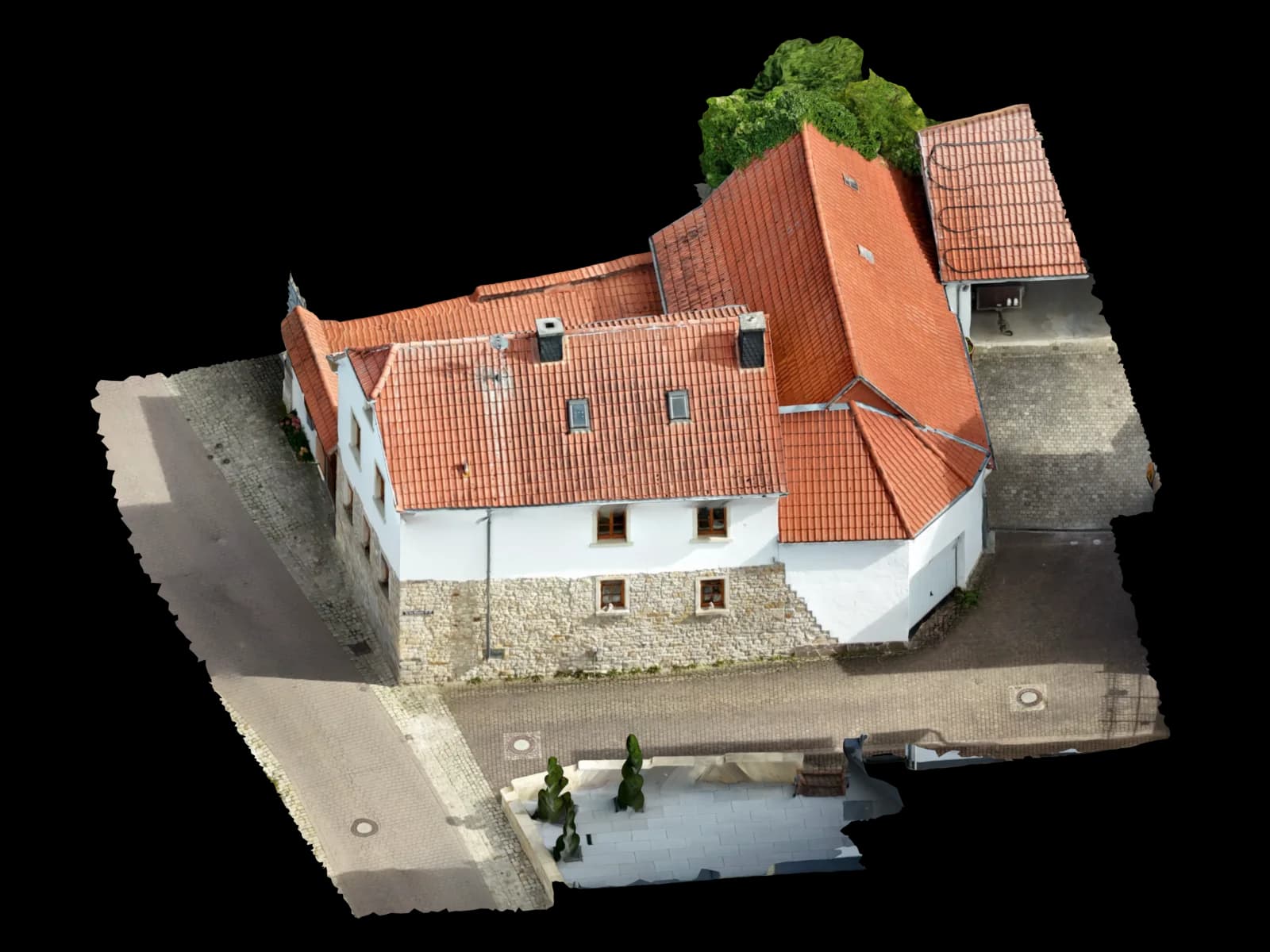
Photogrammetry is an old, proven technology: Multiple photos from different angles are combined to reconstruct a precise 3D model. Modern terminology calls this "Structure from Motion" (SfM) — the software analyzes overlapping regions between images and derives geometry and depth from them.
The method uses only a standard camera (like in any smartphone or drone), which keeps equipment costs low. The resulting 3D model is high-resolution and includes original color information (RGB textures) — ideal for realistic visualization and photogrammetric analysis.
Photogrammetry has one weakness: it doesn't work in heavy rain, dense fog, or complete darkness — the camera needs light to capture images. It works in cloudy conditions, but shadowed areas may be reconstructed incorrectly.
What is LiDAR?
LiDAR stands for "Light Detection and Ranging" and works with laser pulses. The sensor emits billions of laser pulses that are reflected by objects. The time until the signal returns is measured — and from that, the exact distance is calculated.
The result is a massive point cloud with millions of individual 3D positions. LiDAR works actively (the sensor generates its own light) and therefore functions in complete darkness, rain, and snow. This makes LiDAR ideal for forestry (vegetation penetration) and night surveying.
The disadvantage: LiDAR stores NO color information — it's pure geometry capture. The resulting point clouds are very large (100-1000 MB) and require specialized software for processing. LiDAR drones are also significantly more expensive than photogrammetry drones.
Technical Comparison: Photogrammetry vs. LiDAR
Both methods have pros and cons. Which method fits your project? Here's a detailed comparison across all important dimensions.
| Criterion | Photogrammetry | LiDAR |
|---|---|---|
| Operating Principle | Structure from overlapping images | Laser distance measurement |
| Resolution GSD | 1-5 cm (full coverage) | 2-10 cm (point spacing) |
| Color Information | Yes, high-quality (RGB texture) | No, geometry only |
| Works in Darkness | No, needs light | Yes, active sensor |
| Penetrates Vegetation | No, sees surface only | Yes, multiple echoes |
| Hardware Cost | From €500 (standard drone) | From €10,000+ (LiDAR module) |
| Processing Time | 24-48h (mesh reconstruction) | 2-12h (point cloud) |
| Output File Size | Medium (OBJ: 200-800 MB) | Large (LAS: 500-2000 MB) |
Accuracy: Who is More Precise?
Both methods can produce cm-accurate 3D models — with RTK drones, horizontal accuracy is 1-3 cm. The difference lies in vertical accuracy and special applications.
Photogrammetry with RTK achieves vertical accuracies of 3-5 cm — ideal for architecture, roof planning, and city surveying. The measurement depends on sufficient visual features (contours, textures). In structureless areas (water surfaces, snow), reconstruction fails.
LiDAR is more robust in difficult conditions and achieves vertical accuracies of 5-10 cm even on structureless surfaces. LiDAR is therefore superior for forestry, river surveying, and terrain mapping. For architecture and technical drawings, photogrammetry is the better choice.
Application Areas: When to Use What?
Photogrammetry is ideal for: Solar planning (high-quality RGB textures for roof models), architecture and BIM projects (exact room dimensions), real estate agents (photorealistic sales materials), heritage protection (detailed facade reconstruction), inventory management (stock assessment with images).
LiDAR is ideal for: Forestry (tree heights, forest biomass), river and coastal surveying (even in difficult conditions), infrastructure management (power line clearance, vegetation height), night surveys (security, inspections), large-area terrain mapping (topographic data capture).
Most large projects benefit from a combination: LiDAR for complete geometry (even under vegetation), photogrammetry for high-quality visualization and detail.
The Hybrid Approach: Photogrammetry + LiDAR
Modern drone surveying teams increasingly use both methods combined. One LiDAR flight delivers complete geometry and vegetation heights — then a photogrammetry flight for color and high-resolution textures. In post-processing, both datasets are registered and merged.
The result: A 3D model with complete geometry (LiDAR) and photorealistic textures (photogrammetry). This is the solution for architects who need both BIM accuracy and visualization quality.
Voxelia supports both methods individually and in combination. You can choose between methods or order both — our team advises you on what's ideal for your project.
Conclusion: Which Method Should You Choose?
If you want to save budget and need high-quality visualizations: Photogrammetry. The method is cheaper, delivers photorealistic textures, and works excellently for architecture, solar planning, and real estate.
If you have forest surveying, night inspections, or extreme conditions: LiDAR. The method is robust and penetrates vegetation — perfect for forestry and infrastructure.
If you want the best solution: Combine both methods. This is the gold standard in modern drone surveying technology and is used by professional teams worldwide. Voxelia offers both options — with individualized consultation for your project.